
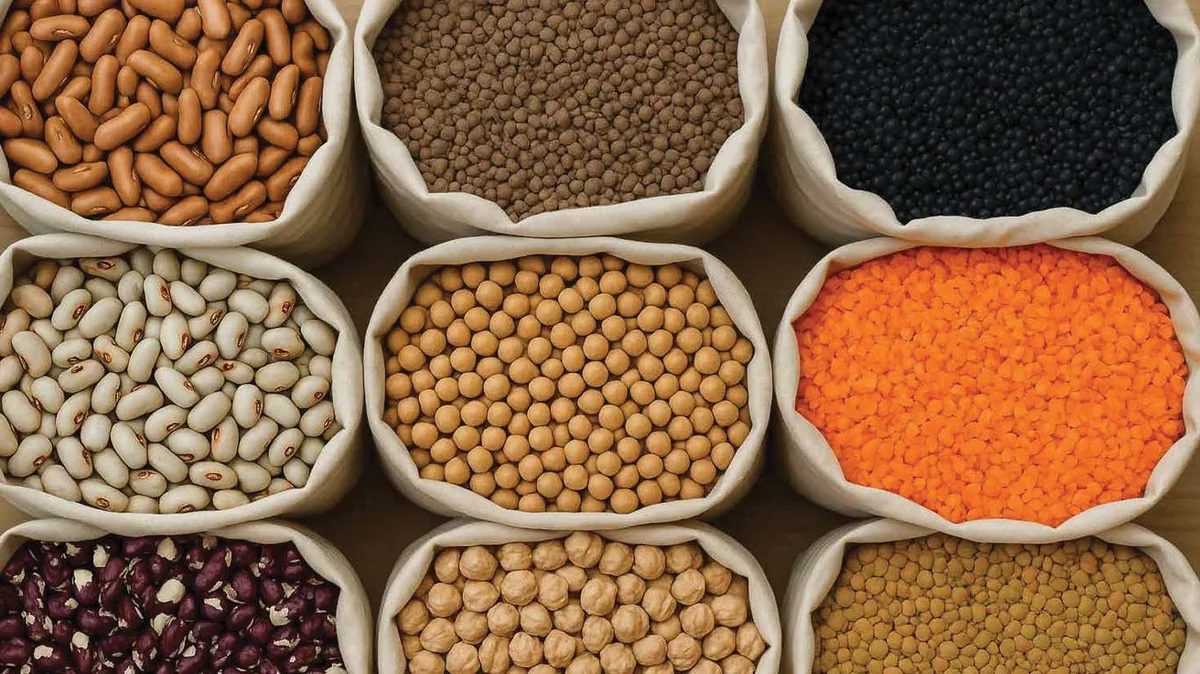
Premium Pulses
Eversure Globals exports high-grade Indian pulses including chickpeas, lentils, and moong to importers worldwide. Sourced from top Indian farms and rigorously graded.
Why Indian Pulses?
India is the world's largest producer and consumer of pulses. Our chickpeas, lentils, and moong are sourced from the fertile plains of Madhya Pradesh and Maharashtra, known for high protein content and consistent quality.
Export Specifications
- Protein: 20-25%
- Moisture: Maximum 14%
- Foreign Matter: Maximum 0.5%
- Broken: Maximum 2%
- Microbiological: EU/FDA compliant
- Packaging: Food-grade PP bags
Shipping & Logistics
Shipped via sea freight in containers. Transit: Middle East (10-15 days), Europe (20-25 days), Africa (18-28 days).
Comprehensive Pulses Export Guide
HS Code & Import Tariffs
HS Codes vary by pulse: Toor Dal 0713.20, Chana Dal 0713.20, Moong Dal 0713.31, Masoor 0713.40. Duties: USA (0% GSP), UK (0%), EU (0%), UAE (0% GCC), Canada (0%).
Seasonal Availability & Best Buying Months
Pulses are harvested at different times: Toor (Nov-Jan), Chana (Mar-Apr), Moong (Mar-May), Masoor (Apr-May). Best procurement is 1-2 months post-harvest when prices are lowest and quality is freshest.
Quality Grades Explained
Premium: Uniform size, max 0.5% foreign matter, polished, no splits. Grade A: Standard size, max 1% foreign matter, minimal splits. Standard: Max 2% foreign matter, suitable for processing. Premium commands 10-15% premium.
Lab Testing & Certifications
Every shipment tested for moisture, protein, foreign matter, and microbial parameters. We hold FSSAI and APEDA. Organic certification available for select varieties. All shipments include lab reports and quality certificates.
Shipping Timeline by Destination
Middle East: 10-14 days. Europe: 20-28 days. USA: 25-35 days. Canada: 25-30 days. Standard dry containers with moisture-barrier laminated bags to prevent spoilage.
Minimum Order & Pricing
Minimum: 1 FCL 20ft (~24-26 MT). LCL from 5 MT. Pricing: Toor Dal $1,200-1,600/MT FOB. Chana Dal $1,000-1,400/MT FOB. Moong Dal $1,800-2,400/MT FOB. Masoor Dal $900-1,200/MT FOB. Urad Dal $1,600-2,200/MT FOB. Contact for current rates.
Why Buyers Choose Eversure Globals for Pulses Exports
Direct Farm Sourcing
We source Toor, Chana, Moong, Masoor, and Urad dal directly from certified farms in Madhya Pradesh, Maharashtra, and Karnataka. Direct sourcing reduces costs by 8-12% and ensures consistent quality.
Export Packaging Options
Pulses are packed in 25kg and 50kg PP bags (standard), 5kg and 10kg retail packs, and 1kg pouches for supermarkets. All packaging uses food-grade laminated materials with moisture barriers.
Quality Control at Every Stage
Our QC includes moisture testing, protein content verification, foreign matter screening, and microbial testing. Every batch is tested by third-party labs. Rejection rate is below 2%.
Flexible Payment Terms
We accept 30% advance + 70% BL copy, Letter of Credit at sight, and escrow for first-time buyers. Regular buyers qualify for 45-day open account terms after three successful shipments.
Pulses Export FAQ
Most profitable pulse to import?
Moong Dal commands highest price ($1,800-2,400/MT) due to global demand for protein-rich, easily digestible lentils. Toor Dal has largest volume. Chana Dal offers best value for institutional buyers.
Packaging for export?
Standard uses 25kg and 50kg laminated PP bags with moisture barriers. Retail packs include 5kg, 10kg, and 1kg pouches. All packaging includes batch numbers, origin labels, and best-before dates. Palletization available for FCL orders.
Shelf life of exported pulses?
Properly stored pulses maintain quality 12-18 months below 25 degrees C with 60 percent humidity. Split dals have shorter shelf life of 9-12 months due to exposed inner surfaces.
Quality testing?
Testing includes moisture (max 14 percent), protein content, foreign matter, broken percentage, and microbial parameters. Premium grades require moisture below 12 percent and zero foreign matter.
Organic certified pulses?
Yes. NPOP and USDA Organic certified pulses from Madhya Pradesh and Maharashtra farms. Organic commands 15-25 percent premium in health-conscious markets.
Minimum order?
Minimum is 1 FCL 20ft with 24-26 MT. LCL from 5 MT for regular buyers. We recommend ordering 1-2 months post-harvest for best pricing.
Get Your Pulses Quote.
Share your required variety, quantity, and destination. Our export team responds within 24 hours.
Request Pulses Pricing
Global Pulses Market Insights 2025
Market Size & Growth
The global pulses market exceeds $80 billion, with India being the largest producer and consumer. India also exports significant quantities of chickpeas, lentils, mung beans, and pigeon peas to the Middle East, Europe, and North America. Global demand grows at 3-4% CAGR, driven by plant-based protein trends.
Top Importing Countries
UAE, Saudi Arabia, UK, USA, Canada, Bangladesh, and Pakistan are the largest importers of Indian pulses. The UAE imports over 500,000 MT annually for re-export and local consumption. UK and USA demand is driven by South Asian diaspora communities and health-conscious consumers seeking plant protein.
Organic & Split Pulses Trends
Organic pulses exports have grown 18% in 2024. Split and processed pulses (dal) command 20-30% higher prices than whole pulses due to convenience and reduced cooking time. Sprouted pulses and pulse-based flours are emerging high-margin segments in North American health food markets.
Quality Standards & Testing
Export-grade pulses require moisture below 14%, foreign matter below 0.5%, and zero live infestation. Fumigation with methyl bromide or phosphine is mandatory for sea shipments. EU-bound pulses must comply with strict aflatoxin limits (below 4 ppb for B1) and pesticide MRL standards.